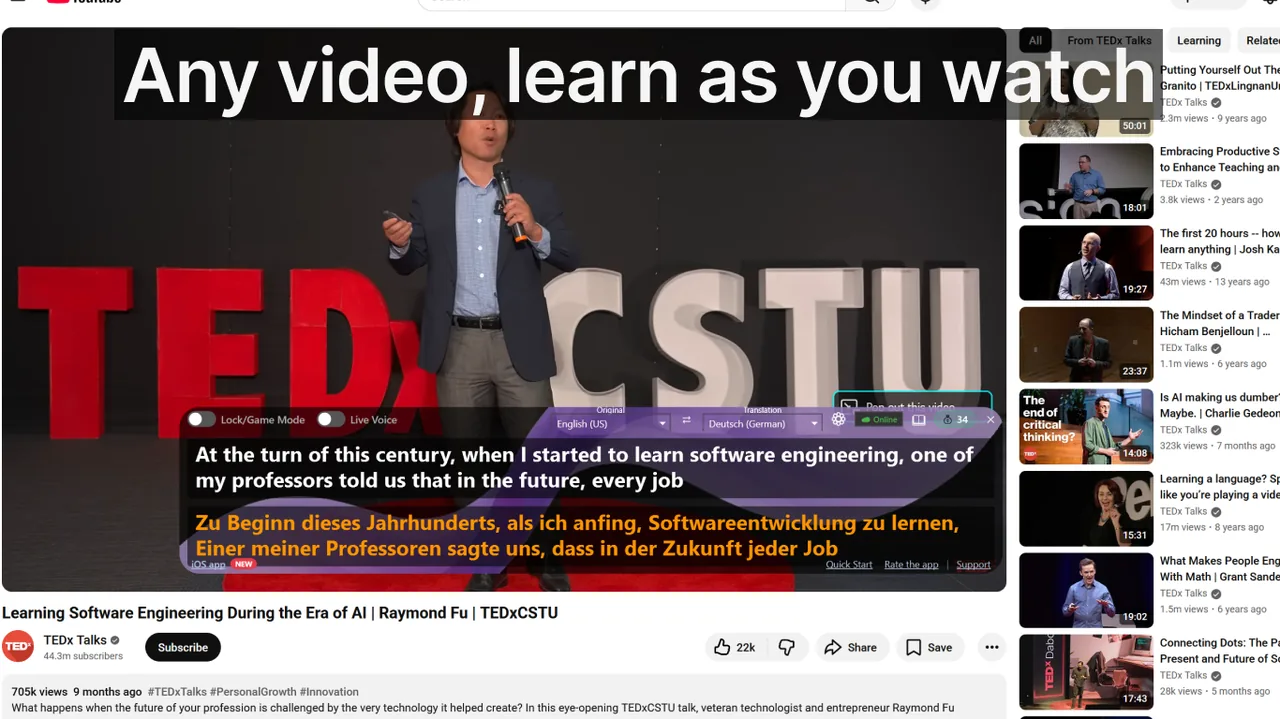
Language textbooks teach you grammar rules. Flashcard apps drill vocabulary into your memory. But there is one learning method that does something none of these tools can do on their own: it places you inside the living, breathing world of a language. That method is watching movies and TV shows in a foreign language. When done consistently and with the right approach, it can transform your listening comprehension, vocabulary range, pronunciation, and cultural fluency in ways that feel almost effortless.
This is not just a feel-good theory. Research in second language acquisition has repeatedly shown that extensive exposure to authentic audio input is one of the strongest predictors of long-term language proficiency. Movies deliver exactly that kind of input — rich, varied, emotionally engaging, and packed with real-world context.
Contents
- Why Movies Are One of the Best Language Learning Resources
- The Immersive Learning Effect: Natural Speech, Real Context, Cultural Exposure
- How Different Movie Genres Benefit Different Language Skills
- The "Three-Pass" Movie Watching Method
- Building a Consistent Movie-Watching Habit for Language Learning
- How to Choose Movies Appropriate for Your Level
- Tracking Your Progress Through Movie Comprehension
- The Role of Repetition: Why Rewatching Helps
- A Practical Schedule: How Many Hours Per Week for Real Results
- Making the Most of Technology
- Final Thoughts
Why Movies Are One of the Best Language Learning Resources
Consider what a single film gives you in just two hours. You hear dozens of different speakers. You encounter formal and informal registers, emotional outbursts, whispered confessions, rapid-fire arguments, and calm explanations. You see body language, facial expressions, and environmental context that help you decode meaning even when you do not catch every word. No textbook dialogue can replicate this richness.
Movies also solve one of the biggest problems in language learning: motivation. Studying grammar tables requires discipline. Watching a gripping thriller in Spanish or a heartfelt Korean drama requires almost none — because you genuinely want to know what happens next. This intrinsic motivation keeps learners coming back session after session, which is ultimately what produces results.
Beyond motivation, films provide something linguists call comprehensible input in context. When a character says something you do not fully understand, the visual scene, the other characters' reactions, and the story arc help you fill in the gaps. Over time, your brain starts mapping unfamiliar words and structures to their meanings automatically, without conscious translation.
The Immersive Learning Effect: Natural Speech, Real Context, Cultural Exposure
Classroom audio recordings are typically spoken slowly, clearly, and in standard dialect. Real life is nothing like that. People mumble, interrupt each other, use slang, drop syllables, and speak with regional accents. Movies expose you to all of these features of natural, unscripted-feeling speech.
This exposure is critical because it trains your ear to handle the unpredictability of real conversation. If you only ever listen to clean, slow, textbook audio, you will struggle the first time a native speaker talks to you at normal speed. Movies bridge that gap.
Cultural exposure is another enormous benefit. Language and culture are inseparable. When you watch a French film, you do not just hear French — you see how French people greet each other, how they express disagreement, what they consider funny, and how social hierarchies play out in conversation. This cultural literacy is what separates someone who merely knows a language from someone who can actually use it comfortably in real situations.
How Different Movie Genres Benefit Different Language Skills
Not all movies teach the same things. Choosing your genre strategically can help you target specific areas of your language ability.
Comedies and Sitcoms: Slang, Idioms, and Everyday Speech
Comedy relies heavily on wordplay, cultural references, and colloquial language. Watching comedies exposes you to informal speech patterns, slang, and idiomatic expressions that you will rarely find in a textbook. Sitcoms are especially useful because their short episodes and recurring characters make it easy to follow along and pick up repeated phrases.
Dramas: Emotional Vocabulary and Complex Sentences
Dramatic films tend to feature longer, more complex dialogue. Characters express nuanced emotions — grief, jealousy, hope, betrayal — using a wide range of vocabulary. If you want to move beyond basic conversational phrases and develop the ability to express subtle feelings and opinions, dramas are your best choice.
Documentaries: Formal Speech and Specialized Vocabulary
Documentaries expose you to clear, well-structured narration. The speech is typically slower and more deliberate than in fiction, making it excellent for intermediate learners who are still building confidence. You will also encounter specialized vocabulary related to science, history, nature, or whatever topic the documentary covers.
Action and Thriller Films: Quick Comprehension Under Pressure
Action movies feature fast-paced dialogue, interruptions, and high-emotion speech. While they can be challenging, they train your ability to extract meaning from rapid, fragmented conversation — a skill you will need in real-world situations like busy restaurants or group discussions.
Animated Films: Clear Pronunciation and Simple Vocabulary
Animation is often an underrated resource for language learners. Voice actors in animated films typically use clear, expressive pronunciation, and the vocabulary tends to be simpler. This makes animated movies a perfect starting point for beginners or anyone working on pronunciation.
The "Three-Pass" Movie Watching Method
One of the most effective techniques for turning passive movie watching into active language learning is the three-pass method. Instead of watching a film once and moving on, you watch it three times, each with a different focus.
Pass 1: Overview with Native Language Subtitles
On your first viewing, watch the film with subtitles in your native language. The goal here is simply to enjoy the story and understand the plot. Do not worry about catching foreign words. By understanding the story first, you create a mental framework that will make the foreign dialogue much easier to decode on subsequent viewings.
Pass 2: Active Study with Foreign Language Subtitles
On your second viewing, switch to subtitles in the foreign language. This is the most intensive pass. Pause frequently to look up unfamiliar words. Notice how spoken words match or differ from the written subtitles. Pay attention to sentence structure, verb tenses, and connecting words. Keep a notebook or digital document open to jot down new vocabulary and phrases. Tools like the Live Subtitles app can be particularly helpful here, as they provide real-time subtitle translation that lets you compare languages side by side without constantly pausing.
Pass 3: Free Listening with No Subtitles
On your third viewing, turn off all subtitles. Now you are testing your comprehension. Because you already know the story and have studied the vocabulary, you will be surprised at how much you can understand purely through listening. This pass trains your ear and builds the kind of real-time comprehension you need for live conversation.
You do not need to complete all three passes in a single day. Spacing them out over a week or two can actually improve retention, as it takes advantage of the spaced repetition effect that memory research has consistently supported.
Building a Consistent Movie-Watching Habit for Language Learning
The key word in this article's title is "regular." Watching one foreign language film every few months will not produce meaningful results. Building a consistent habit is what makes the difference.
Here are practical strategies for making movie watching a sustainable part of your routine:
- Set a specific schedule. Decide on two or three evenings per week that are your "language movie nights." Treating it as an appointment makes it harder to skip.
- Start with short content. If two-hour films feel intimidating, begin with 20-30 minute TV episodes. Series have the added benefit of recurring vocabulary and characters you become familiar with over time.
- Replace, do not add. Instead of adding language watching on top of your existing entertainment, replace some of your regular viewing. If you normally watch an hour of TV in the evening, make one of those hours a foreign language show.
- Use a streaming routine. Keep a dedicated watchlist of foreign language content on your streaming platform so that when you sit down to watch, the next episode is always ready.
- Track your sessions. A simple calendar where you mark each day you watched something in your target language provides a visual streak that motivates consistency.
How to Choose Movies Appropriate for Your Level
Choosing content that is too easy will bore you. Choosing content that is too difficult will frustrate you. The sweet spot is what linguists call "i+1" — input that is just slightly above your current level.
Here are guidelines for each proficiency stage:
Beginner (A1-A2)
- Children's animated films and cartoons
- Simple sitcoms with visual humor
- Films you have already seen in your native language (familiarity with the plot reduces cognitive load)
- Content with clear, slow speech and limited slang
Intermediate (B1-B2)
- Romantic comedies and light dramas
- Popular TV series with modern, everyday dialogue
- Documentaries on topics you already know well
- Films with foreign language subtitles available
Advanced (C1-C2)
- Complex dramas with layered dialogue
- Political thrillers and courtroom films
- Stand-up comedy (one of the hardest formats to understand in a foreign language)
- Regional or independent cinema with diverse accents and dialects
Tracking Your Progress Through Movie Comprehension
One of the frustrations of language learning is that progress often feels invisible. Movies provide a natural, built-in way to measure improvement.
Try this simple self-assessment after each viewing:
- Estimated comprehension percentage. After watching without subtitles, estimate what percentage of the dialogue you understood. Write it down. Over weeks and months, you will see this number climb.
- New words captured. Count how many new words or phrases you noted during active viewing. A shrinking number over time means you already know more of the vocabulary.
- Subtitle dependency. Track whether you needed native language subtitles, foreign language subtitles, or no subtitles at all. Moving from the first to the last is one of the clearest signs of progress.
- Rewatch test. Go back and rewatch a film you struggled with months ago. The difference in comprehension can be dramatic and incredibly motivating.
The Role of Repetition: Why Rewatching Helps
There is a reason children can watch the same movie dozens of times without getting bored — and there is a reason they learn language so effectively. Repetition is one of the most powerful mechanisms for language acquisition.
When you rewatch a film, several things happen in your brain:
- Reduced cognitive load. Because you already know the plot, your brain can devote more processing power to the language itself rather than trying to follow the story.
- Pattern recognition. On repeated viewings, you start to notice grammatical patterns, recurring phrases, and sentence structures that you missed the first time.
- Deeper vocabulary encoding. Hearing a word once rarely leads to long-term retention. Hearing it multiple times across different scenes strengthens the neural pathways associated with that word.
- Pronunciation refinement. With each viewing, you become more attuned to the exact sounds, rhythm, and intonation of the dialogue. Many learners find themselves naturally mimicking characters' speech patterns after multiple viewings.
Do not feel guilty about rewatching favorites. It is not laziness — it is one of the most scientifically supported learning strategies available.
A Practical Schedule: How Many Hours Per Week for Real Results
How much movie watching do you actually need to see measurable improvement? While individual results vary, here is a general framework based on common language learning research:
- Minimum effective dose: 3-4 hours per week. This is roughly two films or several TV episodes. At this level, you will maintain your current skills and make slow, steady progress.
- Moderate practice: 5-7 hours per week. At this level, combined with even minimal other study, most learners report noticeable improvement in listening comprehension within 2-3 months.
- Intensive immersion: 10+ hours per week. If you replace most of your entertainment consumption with foreign language content, the results can be remarkable. Many polyglots cite this level of media immersion as one of their primary learning methods.
The important thing is that consistency matters more than volume. Watching one hour every day will produce better results than watching seven hours in a single weekend session, because daily exposure keeps the language active in your memory.
Making the Most of Technology
Modern tools have made foreign language movie watching far more effective than it was even a few years ago. Streaming platforms now offer content in dozens of languages with subtitle options. Browser extensions can provide dual subtitles. And apps like Live Subtitles can generate real-time subtitles for any audio source, which means you are not limited to content that comes with pre-made subtitle files — you can get subtitles for live TV broadcasts, video calls, podcasts, and more.
The combination of abundant foreign language content and powerful subtitle technology means that there has never been a better time to use movies as a core part of your language learning strategy.
Final Thoughts
Watching movies in a foreign language is not a shortcut, and it is not a replacement for grammar study or speaking practice. But it is one of the most enjoyable, sustainable, and effective ways to build listening comprehension and vocabulary. It trains your ear for real-world speech, exposes you to culture, and keeps you motivated in a way that few other methods can match.
Start tonight. Pick a film in your target language. Watch it with subtitles. Pay attention. Come back tomorrow and do it again. Within a few weeks, you will hear the difference — and within a few months, other people will hear it too.
Related Articles
Try Live Subtitles for Free
Get dual subtitles, real-time speech recognition and translation in any application. Works with YouTube, Netflix, Zoom, and 50+ other apps.
Download free