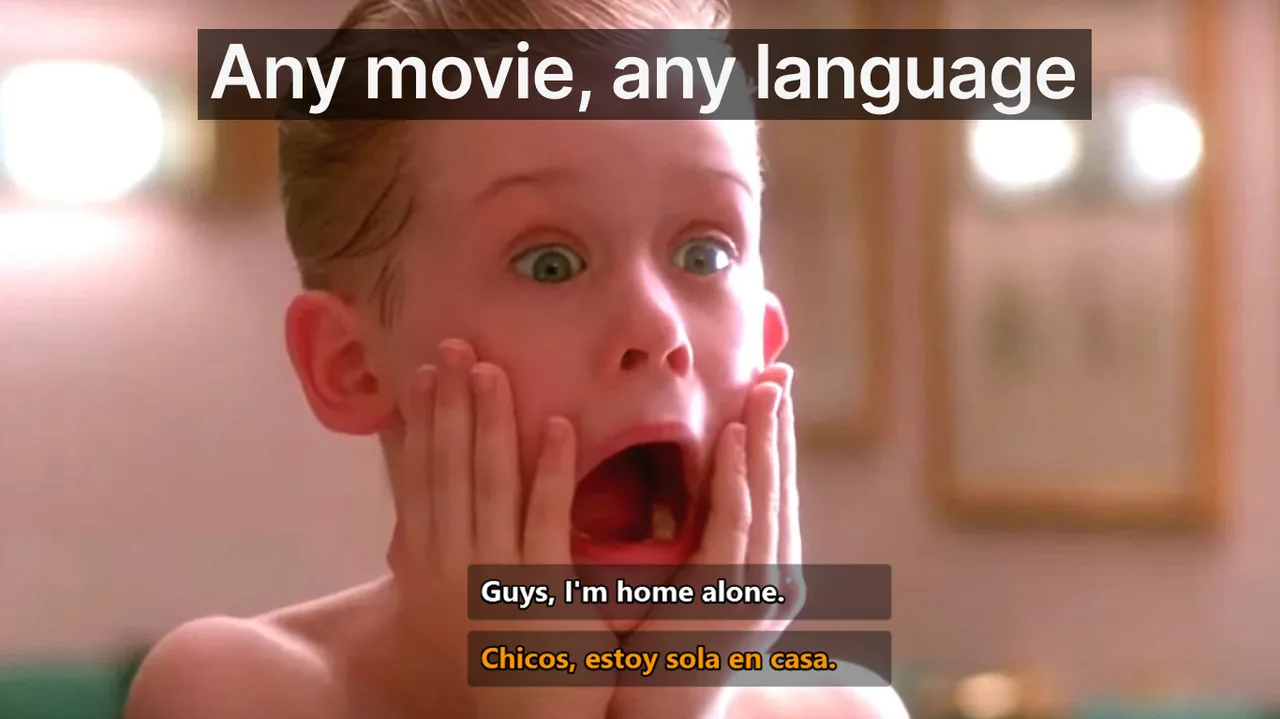
Language learning goes far beyond memorizing vocabulary lists or drilling grammar rules. The deepest, most durable understanding of a foreign language comes from grasping the culture that shaped it — the unspoken assumptions, the humor, the social hierarchy, the way people argue or apologize or flirt. Cinema is one of the most powerful windows into that world. When you watch a film with subtitles, you are not just decoding words; you are observing how real people behave, what they value, and what makes them laugh or cry. This guide explains exactly why movies with subtitles are so effective for cultural and linguistic immersion, and how to make the most of every viewing session.
Contents
- Why Cinema Is a Cultural Mirror
- The Four Cultural Dimensions Movies Teach Best
- Dual Subtitles: Why Two Languages on Screen Works
- How to Set Up Dual Subtitles on Any Platform
- Choosing the Right Films for Cultural Immersion
- Active Watching vs. Passive Viewing
- Recognizing Cultural Subtext in Dialogue
- Frequently Asked Questions
Why Cinema Is a Cultural Mirror
Every film is a time capsule. A 1990s British drama captures class anxiety in ways no textbook can describe. A contemporary Korean thriller reflects social pressure around academic achievement. A classic Hollywood road movie embodies a distinctly American faith in self-reinvention. Screenwriters, directors, and actors draw on the cultural assumptions of their audience — references they never explain, because every native viewer already understands them.
When you watch with subtitles in the original language, you catch layers that a dubbed version destroys: the rhythm of a joke, the sarcasm in a three-word reply, the loaded silence that tells you more than any speech. Research published in Language Learning & Technology found that learners who watched authentic video content with target-language subtitles scored up to 28% higher on idiom recognition tests than those who relied on coursebooks alone.
The Four Cultural Dimensions Movies Teach Best
Some cultures value bluntness — a German colleague who says "That plan is wrong" is not being rude; directness signals respect. Other cultures rely on indirection — a Japanese character who says "That might be difficult" is almost certainly saying no. Films reveal these conventions in lived action, making abstract cultural theory concrete. After watching a dozen Japanese dramas, the concept of tatemae (public face) and honne (private feeling) stops being a textbook definition and starts feeling intuitive.
Nothing exposes cultural gaps faster than a joke that lands flat in translation. Subtitles force the translator to make a choice: preserve the wordplay and lose the meaning, or keep the meaning and lose the wit. Watching the original with dual subtitles — the target language on screen and your native language as a gloss — lets you compare both solutions in real time and understand why the original is funnier. Over dozens of films, your ear for comedic timing in the foreign language sharpens dramatically.
Languages encode social status in grammar. Japanese has six levels of politeness. Spanish distinguishes formal usted from informal tú. Korean marks relationships through verb endings that change depending on the age and rank of the person being addressed. Films show exactly when characters switch registers — when a young professional suddenly drops into casual speech with a childhood friend, or when someone pointedly uses a formal form to signal distance — and those moments teach you what no conjugation table can.
How do people greet each other in the morning? Who pours the tea? What topics are avoided at the dinner table? Films answer all of these with zero explanation, because the native audience does not need one. Watching a French family argue over politics during a holiday meal, or a Brazilian family negotiate who sits at the head of the table, teaches the implicit rules that govern daily life far more vividly than a cultural overview chapter in a phrasebook.
Dual Subtitles: Why Two Languages on Screen Works
Watching with your native language subtitles alone is comfortable but passive — your brain skips the foreign audio and reads the translation. Watching with no subtitles at all is admirable but exhausting, especially below B2 level. Dual subtitles — target language on top, native language below — hit the sweet spot. You process the spoken word, read the phonetic confirmation, and glance at the translation only when needed. Studies tracking eye movement show that after roughly four weeks of dual-subtitle viewing, learners' gaze shifts overwhelmingly to the target-language line, with translation consulted only for genuinely unfamiliar vocabulary.
For Indonesian learners, this is exactly why film sub indo content with dual-language tracks has become so popular on regional streaming platforms: seeing the original English (or Korean, or Arabic) alongside a Bahasa Indonesia gloss accelerates comprehension of both the language and the cultural context without the frustration of being completely lost.
How to Set Up Dual Subtitles on Any Platform
Getting two subtitle tracks on screen simultaneously used to require technical workarounds. Today there are several practical approaches:
- Dedicated extensions — Browser add-ons for Netflix and YouTube can overlay a second subtitle track, letting you pair, for example, English and Spanish subtitles on the same video.
- Media player software — VLC and MPV can load two separate SRT files, positioning them at different vertical offsets so they do not overlap.
- Live Subtitles app (Windows) — For any content playing on your PC — whether on a streaming service, a locally stored file, or a video call — Download free listens to your system audio in real time and displays a second subtitle overlay in the language of your choice. This works regardless of whether the platform natively supports dual subtitles. It uses on-device AI speech recognition, so there is no upload latency, and it supports over 50 languages. The overlay floats above any window, so you see both the original subtitles burned into the video and the live translation beneath them.
The Live Subtitles approach is particularly powerful for streaming services that do not offer your target language track, for DVDs ripped without subtitle files, or for foreign-language YouTube content with auto-generated captions you want translated simultaneously.
Choosing the Right Films for Cultural Immersion
Not every film is equally useful for cultural learning. Some guidelines:
- Prefer contemporary over classic — Language and culture shift. A 1950s American film teaches the culture of 1950s America, not of today. For practical cultural fluency, weight your list toward films from the last 10–15 years.
- Mix genres — Dramas expose emotional vocabulary and family dynamics. Comedies reveal humor and taboo. Crime thrillers show institutional culture, class, and corruption. Romantic comedies are excellent for social rituals around dating.
- Choose films made for domestic audiences — Films co-produced specifically for international export often sand off the culturally specific edges. A locally made low-budget drama is usually more linguistically authentic than a prestige international co-production.
- Use foreign-language Oscar nominees — The Academy's International Feature Film category provides a curated list of high-quality, culturally specific films: Parasite (Korea), Roma (Mexico), The Great Beauty (Italy), Toni Erdmann (Germany). These are narratively sophisticated and rich with cultural texture.
For a structured watchlist organized by language level and genre, see our TOP-10 Movies with Dual Subtitles for Learning English and our guide on How Regular Foreign Language Movie Watching Improves Your Level.
Active Watching vs. Passive Viewing
There is a meaningful difference between watching a film for relaxation and watching it as a deliberate learning exercise. Neither approach is wrong, but they produce different results. Passive viewing builds a general feel for rhythm, intonation, and cultural context. Active watching accelerates vocabulary acquisition and grammar pattern recognition. A practical routine:
- First pass: Watch the scene with dual subtitles for comprehension and enjoyment.
- Second pass: Rewatch two or three scenes that contained unfamiliar phrases or culturally opaque moments. Pause, look up, and note the expression.
- Third pass: Shadow the dialogue — repeat lines aloud, matching the speaker's rhythm and intonation. This builds pronunciation and embeds phrases into muscle memory.
Even 30 minutes of active watching three times a week, sustained over six months, produces measurable improvements in listening comprehension and spontaneous vocabulary recall.
Recognizing Cultural Subtext in Dialogue
One of the highest-value skills a film learner can develop is reading subtext — what a character means versus what they say. This is intensely cultural. A British character who says "That's very interesting" may be politely dismissing you. An American character who says "We should do lunch sometime" may have no intention of following through. A Russian character's apparent bluntness in a business scene is not aggression — it is efficiency. These readings are invisible to learners working from a pure translation; they require cultural context that films provide naturally.
When you notice a moment where the character's words and actions seem misaligned, pause. That gap is almost always doing cultural work. Search for commentary, read a review written for domestic audiences, or ask in a language-learning forum. Those investigations are among the most valuable learning sessions you will have.
Frequently Asked Questions
A: It depends on your level. At A1–A2, native-language subtitles help you follow the plot so you can focus on sound and intonation. At B1 and above, switch to target-language subtitles or dual subtitles. The goal is to wean yourself off native-language gloss as quickly as is comfortable, because your brain will always take the easier option.
A: Most dedicated learners report a noticeable shift in listening confidence after 20–30 hours of subtitled viewing spread over 6–8 weeks. Cultural intuition — the ability to read subtext and social cues — develops more slowly, typically over several months and dozens of films.
A: Absolutely, and series often work better than films for cultural learning because recurring characters let you track how their speech changes across different social contexts. A 10-episode drama gives you roughly 8–9 hours with the same cultural world — the equivalent of an intensive immersion week.
A: Yes. Live Subtitles captures the audio output of your Windows PC regardless of source — whether you are using a streaming browser tab, a local media player, or a video call. If your PC is playing it, Live Subtitles can transcribe and translate it in real time.
Cinema is not a shortcut to fluency — nothing is. But it is one of the most enjoyable and culturally rich paths available. Every film you watch with intent adds vocabulary, sharpens your ear, and deposits another layer of cultural intuition that no grammar workbook can replicate. The tools to do it well — dual subtitle setups, real-time translation overlays — have never been more accessible. The only remaining step is pressing play.
Related Articles
Try Live Subtitles for Free
Get dual subtitles, real-time speech recognition and translation in any application. Works with YouTube, Netflix, Zoom, and 50+ other apps.
Download free