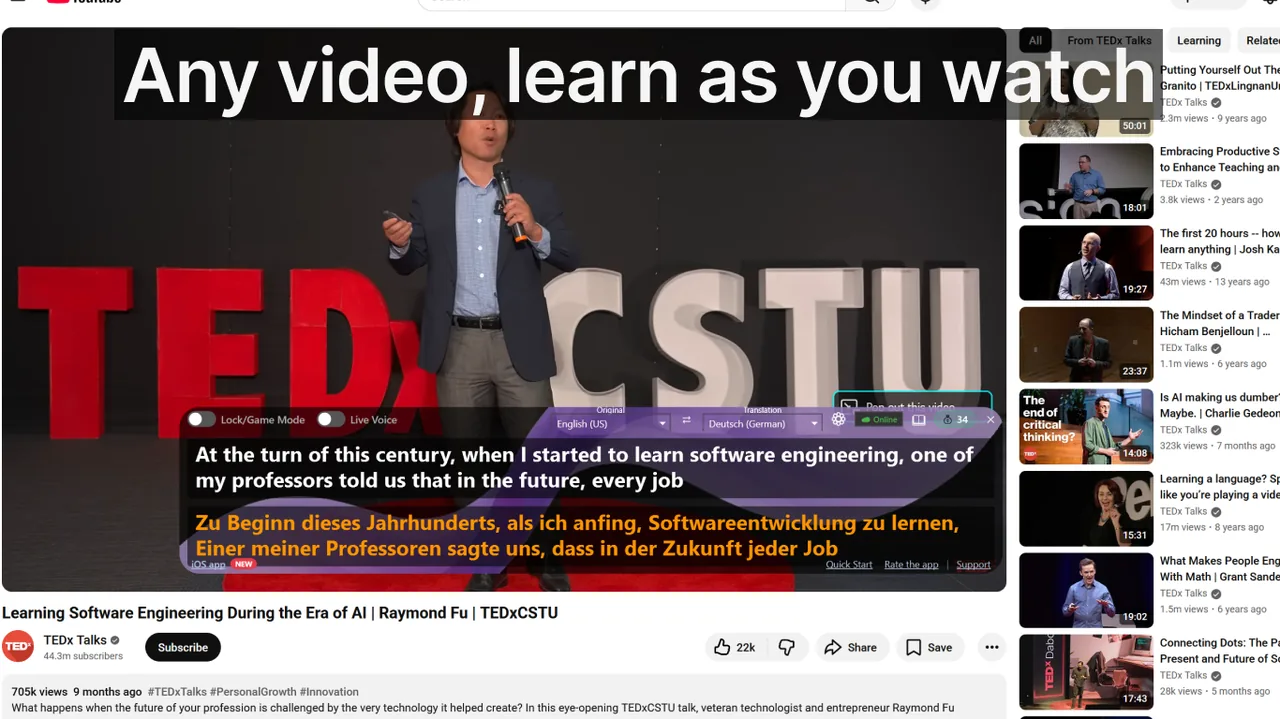
For decades, language learners have been told that the path to fluency runs through textbooks, grammar drills, and vocabulary lists. While those tools have their place, a growing body of scientific research points to a far more natural and effective method that most people overlook: watching content with subtitles. Whether you are streaming a foreign film, joining an international video call, or listening to a podcast in your target language, subtitles bridge the gap between what you hear and what you understand, turning every piece of media into a powerful learning opportunity.
This article examines the science behind subtitle-assisted language learning, explores the different types of subtitles and when to use each, and provides a practical framework for integrating subtitles into your daily routine at any proficiency level.
Contents
- The Science of Subtitles and Language Acquisition
- Types of Subtitles: L1, L2, and Dual
- How Subtitles Reduce Cognitive Load and Anxiety
- Pattern Recognition and Grammar Learning
- Subtitles for Different Learning Styles
- Real-World Applications
- A Progressive Subtitle Strategy
- Accessibility Benefits Beyond Language Learning
- Getting Started: Practical Recommendations
- Conclusion
The Science of Subtitles and Language Acquisition
Multimodal Processing and Memory
The human brain does not process language through a single channel. When you watch subtitled content, your brain simultaneously handles auditory input (the spoken words), visual input (the on-screen text), and contextual input (the images, facial expressions, and situations on screen). This multimodal processing creates what neuroscientists call redundant encoding — the same information is stored through multiple pathways, making it significantly easier to retrieve later.
A landmark study by Mayer and Moreno (2003) on multimedia learning demonstrated that people learn more deeply from words and pictures combined than from words alone. Subtitled video is a textbook example of this principle in action: the spoken language provides the auditory trace, the subtitle text provides the visual-verbal trace, and the on-screen context provides the situational trace. Together, they create a rich, multi-layered memory that is far more durable than any single-channel input.
Incidental Vocabulary Acquisition
One of the most remarkable findings in subtitle research is the power of incidental learning — acquiring new words without deliberately trying to study them. Webb and Rodgers (2009) found that learners who watched subtitled television programs picked up new vocabulary at rates comparable to explicit vocabulary instruction, but with the added benefit of learning words in natural, meaningful contexts. The subtitles provided the written form that anchored the spoken word, while the narrative context provided the meaning. No flashcards required.
The Segmentation Effect
Spoken language is a continuous stream of sound. Unlike written text, there are no spaces between words. One of the most difficult tasks for language learners is parsing this stream into individual words — a skill linguists call speech segmentation. Subtitles solve this problem directly by showing exactly where one word ends and the next begins. Over time, the brain learns to recognize these boundaries in speech alone, even without the visual support. This is why subtitle users consistently outperform non-subtitle users on listening comprehension tests.
Types of Subtitles: L1, L2, and Dual
Not all subtitles serve the same purpose. Understanding the three main types and when to use each is critical for maximizing your learning.
L1 Subtitles (Native Language)
These are subtitles written in your mother tongue while the audio plays in the target language. They ensure full comprehension of the content, which is essential for beginners who would otherwise be lost. Research by Bianchi and Ciabattoni (2008) showed that L1 subtitles significantly improve listening comprehension in early-stage learners by providing a reliable meaning anchor. The risk is over-reliance — if you never move beyond L1 subtitles, you may find yourself reading instead of listening.
- Best for: Complete beginners (A1), understanding complex plots, building initial familiarity with the sound of a language.
- Limitation: Less effective for developing reading skills in the target language.
L2 Subtitles (Target Language)
These display the spoken words in the same language as the audio. They are essentially same-language captions. A meta-analysis by Montero Perez, Van Den Noortgate, and Desmet (2013) found that L2 subtitles produce the strongest gains in vocabulary recognition and form-meaning connections. The learner hears a word, sees it written, and connects both to the on-screen context.
- Best for: Intermediate learners (B1-B2), developing reading speed, reinforcing spelling and word recognition.
- Limitation: Can be frustrating if too many words are unknown, leading to cognitive overload.
Dual Subtitles (Both Languages)
Dual subtitles display both the target-language text and a native-language translation simultaneously. They combine the comprehension guarantee of L1 subtitles with the linguistic exposure of L2 subtitles. Studies by Danan (2004) and others have shown that dual subtitles produce the highest rates of vocabulary acquisition among all subtitle types, particularly for learners at the elementary and intermediate levels.
- Best for: Elementary to intermediate learners (A2-B1), building vocabulary rapidly, understanding grammatical differences between languages.
- Limitation: Can feel visually busy; requires a tool that supports dual-subtitle display.
How Subtitles Reduce Cognitive Load and Anxiety
One of the least discussed but most significant benefits of subtitles is their effect on the emotional dimension of learning. Language anxiety — the fear of not understanding, of making mistakes, of feeling lost — is one of the top barriers to acquisition. Research by Horwitz, Horwitz, and Cope (1986) established that anxiety directly impairs language processing and retention.
Subtitles act as a psychological safety net. When you know that you can always check the text if the audio becomes too fast or unclear, your anxiety drops. Lower anxiety means your working memory is freed up to actually process the language, rather than being consumed by stress. This creates a virtuous cycle: less anxiety leads to better comprehension, which leads to greater confidence, which leads to even less anxiety.
From a cognitive-load perspective, subtitles also help by distributing the processing burden across visual and auditory channels. Instead of your auditory system bearing the entire weight of comprehension, the visual system shares the load. This is particularly important for complex or rapid speech, where the auditory channel alone may be overwhelmed.
Pattern Recognition and Grammar Learning
Grammar is often taught as a set of explicit rules to be memorized. But research in usage-based linguistics suggests that much of grammatical knowledge is actually acquired through pattern recognition — exposure to thousands of examples that allow the brain to extract regularities on its own.
Subtitles accelerate this process in several ways:
- Word order: Seeing sentences written out makes structural patterns visible. You begin to notice that German verbs go to the end of subordinate clauses, or that Japanese particles follow the nouns they modify, without anyone explicitly telling you.
- Verb conjugation: Repeated exposure to verbs in different forms — present, past, conditional — within natural dialogue builds an intuitive sense of how conjugation works.
- Collocations and prepositions: Subtitles reveal which words naturally go together. You learn that in English we say "depend on" rather than "depend from" not because you memorized a rule, but because you saw the correct form dozens of times.
- Register and formality: Written subtitles make it easier to notice when characters switch between formal and informal speech, helping you develop sociolinguistic competence.
Subtitles for Different Learning Styles
Visual Learners
If you learn best by seeing, subtitles are your ideal tool. The written text provides a concrete visual anchor for abstract sounds. You can see spelling patterns, notice prefixes and suffixes, and visually compare sentence structures across languages. Many visual learners report that they "photograph" subtitle lines in their memory, recalling new words by visualizing where they appeared on screen.
Auditory Learners
Subtitles complement auditory processing by confirming what you hear. When a spoken word is ambiguous or unfamiliar, seeing it written resolves the uncertainty immediately. Auditory learners can use subtitles as a bridge, gradually reducing their dependence on the visual text as their listening skills improve. The combination of hearing and reading the same content reinforces both channels simultaneously.
Reading/Writing Learners
For learners who prefer text-based input, subtitles transform audio and video content into a reading exercise embedded in rich context. You get all the benefits of extensive reading — exposure to varied vocabulary, natural sentence structures, and authentic language use — combined with the audio track that teaches pronunciation and prosody.
Kinesthetic Learners
While subtitles are not inherently physical, they can be combined with active techniques like shadowing (repeating dialogue aloud in real time) or dictation (pausing the video and writing what you heard, then checking against the subtitles). These physical activities, paired with subtitle verification, create a complete learning loop.
Real-World Applications
Movies and TV Series
The most popular application. Choose content you genuinely enjoy and watch regularly. Consistency matters more than intensity. Thirty minutes of subtitled viewing per day will produce better results over three months than a six-hour weekend marathon once a month. Series are particularly effective because recurring characters use consistent vocabulary, giving you natural spaced repetition.
Online Meetings and Video Calls
Subtitles are not limited to entertainment. If you work in a multilingual environment, using real-time subtitles during meetings helps you follow discussions accurately while simultaneously building your professional vocabulary. Tools like Live Subtitles generate real-time captions for any audio source, making it possible to have subtitle support in video conferences, webinars, and live presentations.
Podcasts and Audio Content
Audio-only content poses a unique challenge because there are no visual context clues. Adding real-time subtitles to podcasts transforms a potentially frustrating listening exercise into a manageable multimodal experience. You hear the natural speech while seeing the text, which is especially helpful for podcasts that feature rapid dialogue or specialized terminology.
Lectures and Educational Content
Academic content in a foreign language often involves complex vocabulary and dense information. Subtitles ensure you do not miss critical points while simultaneously building your academic register in the target language. University students studying abroad frequently cite subtitled lectures as one of their most effective adaptation tools.
Music and Lyrics
Songs are excellent for language learning because melodies aid memorization. Displaying lyrics as subtitles while listening to music helps you decode fast or unclear singing, learn colloquial expressions, and associate words with emotional contexts that make them highly memorable.
A Progressive Subtitle Strategy
The most effective approach to subtitle-based learning is not static. It evolves as your skills develop. Here is a four-stage progression that moves you from full support to independent comprehension:
Stage 1: Full Support (Beginner)
Watch with dual subtitles or L1 subtitles. Your primary goal is comprehension and exposure. Do not pressure yourself to understand the audio — focus on enjoying the content and absorbing the general sound and rhythm of the language. Duration: the first 1-3 months of study.
Stage 2: Shifting Focus (Elementary to Intermediate)
Switch to dual subtitles with active attention on the L2 line. Begin reading the target-language text first and only glancing at the native-language line for confirmation. Start noticing grammatical patterns and building vocabulary actively. Duration: months 3-8.
Stage 3: Target Language Only (Intermediate)
Remove the native-language subtitles entirely. Watch with L2 subtitles only. You should now be able to follow most dialogue with the help of the written text. Use context to infer unknown words. Pause and look up only words that seem important and recur frequently. Duration: months 8-18.
Stage 4: Minimal Support (Advanced)
Watch without subtitles for most content. Turn on L2 subtitles only for particularly challenging material — fast-paced dialogue, strong accents, technical topics. At this stage, you are training your ear to work independently. Return to dual subtitles occasionally to pick up nuanced vocabulary or to study a specific register. Duration: ongoing.
Accessibility Benefits Beyond Language Learning
While this article focuses on language acquisition, it is worth noting that subtitles serve a much broader purpose. They are essential for deaf and hard-of-hearing individuals, providing access to audio content that would otherwise be inaccessible. They help people with auditory processing disorders, attention difficulties, and cognitive differences engage with media on their own terms.
Subtitles also benefit viewers in noisy environments (commuting, gyms, open offices), those who prefer to watch content at low volume (late at night, in shared spaces), and non-native speakers who live and work in a foreign-language environment. The universal value of subtitles is reflected in growing adoption statistics: studies show that over 80% of viewers who use subtitles are not deaf or hard of hearing.
This broad utility means that tools providing high-quality real-time subtitles — such as the Live Subtitles app, which generates captions for any audio on your device — serve not just language learners but anyone who benefits from seeing words as they are spoken.
Getting Started: Practical Recommendations
- Start today, not tomorrow. The best subtitle strategy is the one you actually use. Pick a show you have been meaning to watch and turn on subtitles.
- Be consistent. Twenty minutes of subtitled viewing every day is more effective than two hours once a week.
- Match subtitle type to your level. Beginners should use L1 or dual subtitles. Intermediate learners should favor L2 subtitles. Advanced learners should default to no subtitles, with L2 as backup.
- Rewatch favorites. Watching the same content multiple times with different subtitle settings is an excellent way to progressively deepen your understanding.
- Combine with active practice. Subtitles build passive knowledge (comprehension). To develop active skills (speaking and writing), complement your viewing with conversation practice and writing exercises.
- Track your progress. Keep a simple log of what you watch and any new words you learn. Seeing your vocabulary grow over weeks and months is a powerful motivator.
Conclusion
Subtitles are far more than a convenience feature or an accessibility add-on. They are a scientifically validated language-learning tool that activates multiple cognitive channels, reduces anxiety, accelerates vocabulary acquisition, and builds grammar intuition through natural pattern recognition. Whether you are a visual learner who needs to see words written out, an auditory learner who needs confirmation of what you hear, or a kinesthetic learner who pairs subtitles with active repetition, there is a subtitle strategy that fits your style.
The research is clear, and the practical barriers are lower than ever. With modern tools that generate real-time subtitles for any audio source, you no longer need to hunt for pre-made subtitle files or limit yourself to content from major streaming platforms. Every conversation, lecture, podcast, and video becomes a potential lesson.
The only step left is to press play.
Related Articles
Try Live Subtitles for Free
Get dual subtitles, real-time speech recognition and translation in any application. Works with YouTube, Netflix, Zoom, and 50+ other apps.
Download free