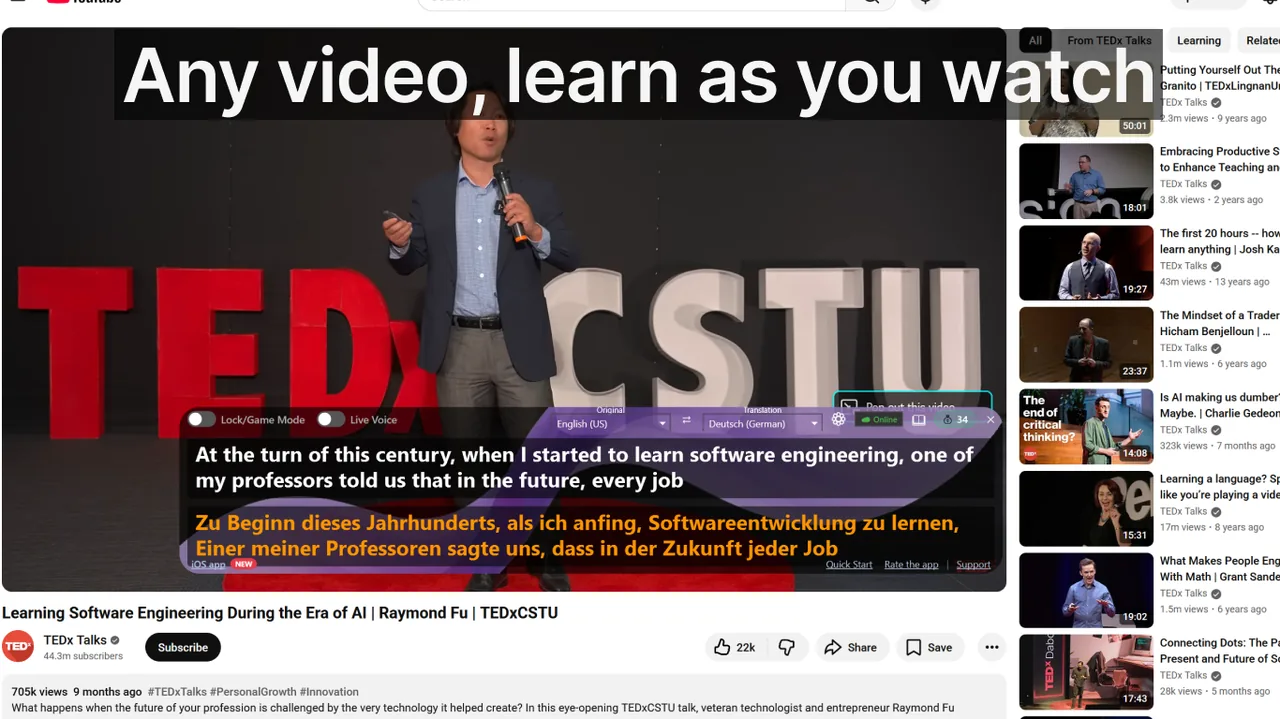
Imagine watching your favorite film and, without consciously studying, absorbing new vocabulary, internalizing grammar patterns, and training your ear to distinguish foreign sounds. That is precisely what happens when you watch content with dual subtitles — two lines of text on screen, one in the language you are learning and one in a language you already understand. What might look like a simple convenience is, in fact, one of the most effective language-learning techniques supported by modern cognitive science.
In this comprehensive guide, we break down the research behind dual subtitles, explain how they activate multiple learning channels at once, and give you a practical roadmap for using them at every proficiency level.
Contents
- The Cognitive Science Behind Dual Subtitles
- How Dual Subtitles Engage Multiple Learning Channels
- Specific Benefits of Dual Subtitles
- A Step-by-Step Guide to Using Dual Subtitles Effectively
- What the Research Says
- Common Myths About Dual Subtitles — Debunked
- Practical Tips for Different Proficiency Levels
- Making It Work in Real Life
- References
- Conclusion
The Cognitive Science Behind Dual Subtitles
Dual-Coding Theory
In 1971, psychologist Allan Paivio proposed dual-coding theory, which states that human cognition operates through two distinct but interconnected systems: a verbal system that processes language and a non-verbal system that processes imagery. When information is encoded through both channels simultaneously, memory retention increases dramatically. Dual subtitles exploit this principle by pairing auditory input (the spoken dialogue), visual-verbal input in the target language (L2 subtitles), and visual-verbal input in the native language (L1 subtitles). The brain forms three parallel memory traces instead of one, making recall far more reliable.
Krashen's Comprehensible Input Hypothesis
Linguist Stephen Krashen argued that language acquisition occurs when learners are exposed to input that is slightly above their current level — what he labeled "i+1." The challenge for most learners is that authentic media like films, podcasts, and news broadcasts are often far beyond i+1. Dual subtitles solve this elegantly: the native-language line ensures comprehension, while the target-language line delivers the stretch input. You always understand what is happening, but you are constantly exposed to new structures in the foreign language.
The Noticing Hypothesis
Richard Schmidt's noticing hypothesis adds another piece to the puzzle. It states that acquisition requires conscious attention to linguistic form. When you see a word written in both languages at the same time you hear it spoken, you cannot help but notice it. This involuntary noticing — comparing the L1 and L2 lines, spotting word-order differences, recognizing cognates — is exactly what drives deep processing and long-term retention.
How Dual Subtitles Engage Multiple Learning Channels
Traditional study methods tend to isolate skills. Flashcard apps drill vocabulary. Grammar textbooks explain rules. Listening exercises test comprehension. Dual subtitles, by contrast, engage four language skills simultaneously:
- Listening: You hear the authentic spoken dialogue, training your ear to segment connected speech, recognize reductions, and follow natural intonation.
- Reading: You see the target-language text, reinforcing spelling, word boundaries, and written conventions that differ from spoken form.
- Vocabulary in context: New words appear within meaningful sentences, surrounded by context clues and an immediate translation, which is far more effective than isolated word lists.
- Grammar through pattern recognition: By comparing sentence structures across two languages, you begin to internalize word order, verb conjugation, and case usage without memorizing abstract rules.
This multi-channel engagement means that a single hour of dual-subtitle viewing can touch more linguistic dimensions than an hour of any single traditional exercise.
Specific Benefits of Dual Subtitles
Accelerated Vocabulary Acquisition
Research in educational psychology and second-language acquisition shows that learners using captioned or bilingual subtitle conditions often acquire vocabulary faster than audio-only or single-channel conditions. The reason is straightforward: when a new word appears, you do not need to pause, open a dictionary, and break your flow. The translation is right there, allowing you to absorb the meaning and immediately return your attention to the dialogue. Over time, words that you initially needed the L1 line to understand gradually become recognizable on their own.
Intuitive Grammar Understanding
Grammar is often the most intimidating part of learning a language. Dual subtitles take a different approach from textbooks. Instead of presenting rules in isolation ("the past participle of irregular verbs must be memorized"), they show you hundreds of real examples in context. You see how native speakers actually construct sentences, which prepositions follow which verbs, and how tense and aspect work in practice. After enough exposure, correct grammar starts to "feel right" — the same way it does for native speakers who never studied formal grammar rules.
Pronunciation and Prosody
Seeing a word written while hearing it spoken creates a strong phoneme-grapheme mapping. You learn not only what a word sounds like, but how its pronunciation relates to its spelling. This is especially valuable for languages with irregular pronunciation systems like English or French. Over time, you develop the ability to predict how unfamiliar written words should sound, and vice versa.
Listening Comprehension
One of the biggest obstacles in language learning is the moment you step outside the classroom and encounter real speech. Native speakers talk fast, swallow syllables, use slang, and rarely enunciate the way textbook recordings do. Dual subtitles provide a safety net: you are immersed in authentic speech, but you can always verify what was said by checking the text. Gradually, your brain learns to parse rapid, natural speech without needing the visual support.
Cultural Fluency
Language is inseparable from culture. Dual subtitles expose you to idioms, humor, cultural references, and register shifts that textbooks rarely cover. When a character uses a colloquial expression, you see both the literal foreign text and a meaningful translation, giving you the cultural context that makes language come alive.
A Step-by-Step Guide to Using Dual Subtitles Effectively
Not all viewing is equally productive. Here is a structured approach that moves you from passive entertainment to active learning.
Step 1: Choose Appropriate Content
Select material that genuinely interests you. Motivation is the single strongest predictor of language-learning success. If you love cooking, watch cooking shows. If you follow technology, watch tech reviews. The content should be slightly challenging but not overwhelming. For beginners, animated films and children's programming offer clearer pronunciation and simpler vocabulary. For intermediate learners, dramas and talk shows provide richer language.
Step 2: First Pass — Relaxed Viewing
Watch a scene or short episode once with dual subtitles enabled. Do not try to memorize anything. Simply enjoy the content and let your brain make natural connections between what you hear, the L2 text, and the L1 translation. This passive immersion primes your memory for deeper processing later.
Step 3: Second Pass — Active Noticing
Watch the same scene again. This time, actively focus on the target-language subtitle line. Try to read along with the spoken dialogue. When you spot an interesting word or phrase, pause briefly and compare the two subtitle lines. Notice how the sentence is structured differently in each language. Say the new word out loud to engage your articulatory memory.
Step 4: Selective Note-Taking
Keep a small notebook or digital note open. After each scene, jot down three to five new words or expressions that stood out. Do not try to record everything — selectivity improves retention. Write the word in the target language, its translation, and a short note about the context in which it appeared.
Step 5: Review and Spaced Repetition
Transfer your notes into a spaced-repetition system (such as Anki or a simple flashcard app). Review them at increasing intervals. Because each word is linked to a vivid scene, a character, and an emotion, you will find these contextual flashcards far more memorable than vocabulary pulled from a textbook list.
Step 6: Gradual Subtitle Reduction
As your proficiency grows, begin reducing your reliance on the native-language line. Switch to target-language subtitles only. Eventually, try watching without any subtitles at all, returning to dual mode only when you encounter material that is significantly above your level.
What the Research Says
A growing body of academic research supports the effectiveness of bilingual subtitles for language acquisition:
- A study by Danan (2004) found that subtitled video significantly enhanced vocabulary recall and listening comprehension compared to non-subtitled video, with the strongest gains observed when both L1 and L2 subtitles were available.
- Research by Bird and Williams (2002) demonstrated that learners who saw written forms of new words while hearing them showed substantially better word recognition in subsequent tests, supporting the dual-coding mechanism.
- Vanderplank (2010) conducted longitudinal studies showing that regular subtitle use over several months led to measurable improvements in incidental vocabulary learning, even when participants were not explicitly trying to study.
- A meta-analysis by Montero Perez et al. (2013) concluded that captions and subtitles consistently lead to better vocabulary acquisition than audio-only conditions, and that the benefit is strongest when learners have access to both the target-language text and a translation.
Common Myths About Dual Subtitles — Debunked
Myth 1: "Subtitles are a crutch that prevents real learning"
This is perhaps the most persistent misconception. Research consistently shows the opposite: subtitles scaffold comprehension, allowing learners to engage with material they would otherwise find impenetrable. The key is to use them strategically and reduce reliance over time, not to abandon them prematurely.
Myth 2: "You will just read the native-language line and ignore the foreign one"
Eye-tracking studies reveal that even when both lines are present, learners naturally shift attention toward the target-language text, especially as their proficiency increases. The native-language line serves as a verification tool, not a replacement for engagement with the foreign text.
Myth 3: "Dual subtitles are only useful for beginners"
Advanced learners benefit from dual subtitles when encountering specialized vocabulary, regional dialects, or complex literary language. Even professional translators and interpreters use bilingual text alignment as a learning and reference technique.
Myth 4: "Watching TV is not real studying"
Acquisition through meaningful, contextualized input is one of the most well-supported principles in second-language research. Watching content with dual subtitles is not a substitute for all forms of study, but it is a highly effective complement that develops skills traditional exercises often miss.
Practical Tips for Different Proficiency Levels
Beginners (A1-A2)
- Start with short clips (3-5 minutes) rather than full films to avoid cognitive overload.
- Choose content with clear, slow speech: children's shows, language-learning channels, or animated films.
- Focus on the native-language line for comprehension, glancing at the target-language line for familiar words.
- Aim to learn 5-10 new words per session.
Intermediate (B1-B2)
- Move to full episodes of series or documentaries.
- Focus primarily on the target-language subtitle line, using the native line only for verification.
- Start shadowing: repeat what characters say immediately after them, matching rhythm and intonation.
- Pay attention to collocations and phrasal verbs rather than individual words.
Advanced (C1-C2)
- Use dual subtitles only for highly technical or dialectal content.
- Switch to target-language-only subtitles for most viewing.
- Focus on nuance, register, and style rather than basic comprehension.
- Use dual subtitles as a translation exercise: cover the native-language line and try to translate mentally before checking.
Making It Work in Real Life
The biggest advantage of dual-subtitle learning is that it fits naturally into your daily routine. You do not need to carve out extra study time — you simply change how you consume media you already enjoy. Morning news, evening series, weekend films, YouTube tutorials — any content you would watch anyway becomes a language lesson.
Tools like Live Subtitles make this especially practical by generating real-time dual subtitles for any audio source, whether you are watching a streaming service, attending an online meeting, or listening to a podcast. The ability to get bilingual subtitles on demand, without relying on pre-made subtitle files, removes the last barrier between you and consistent, immersive practice.
References
- Danan (2004): captioning and subtitling research overview
- Bird & Williams (2002): spoken + written word-form learning
- Vanderplank (2010): subtitles in second-language learning
- Montero Perez et al. (2013): captioned video and vocabulary learning
Conclusion
Dual subtitles are not a shortcut or a gimmick. They are a scientifically grounded technique that leverages how the human brain naturally processes and retains language. By combining auditory input, target-language text, and native-language verification in a single engaging experience, they compress what would otherwise take months of isolated study into a fraction of the time.
Whether you are just starting with a new language or polishing advanced skills, incorporating dual subtitles into your media consumption is one of the highest-return investments you can make in your language-learning journey. Start with content you love, follow the step-by-step approach outlined above, and watch your comprehension grow faster than you thought possible.
Related Articles
Try Live Subtitles for Free
Get dual subtitles, real-time speech recognition and translation in any application. Works with YouTube, Netflix, Zoom, and 50+ other apps.
Download free