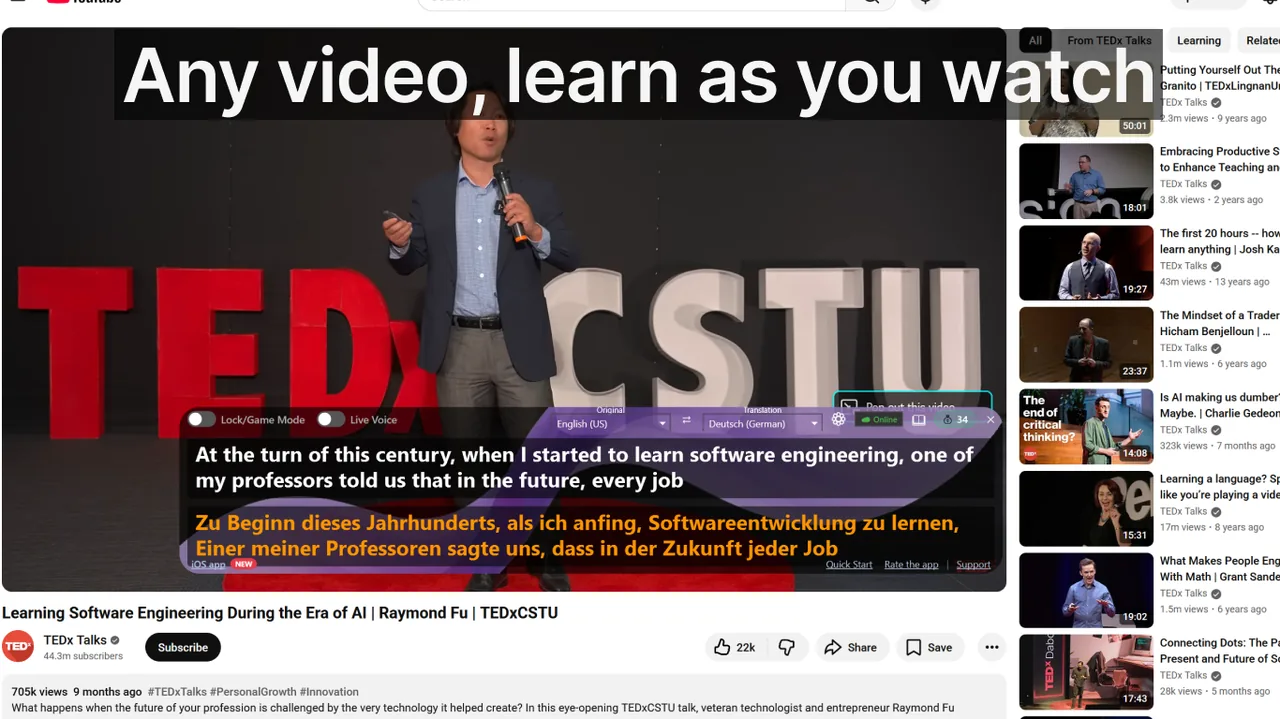
There is a common assumption that subtitles are only for people watching content in a foreign language. If you are a native English speaker watching an English-language show, why would you need text on screen? You already understand the language. But a growing body of research — and the viewing habits of millions of people — tells a very different story. Subtitles offer significant benefits even when you are watching content in your own language.
From improved information retention to better comprehension of accents and technical terminology, the reasons native speakers turn on subtitles are practical, cognitive, and sometimes surprising. Let us examine each one in detail.
Contents
- Research Shows Native Speakers Retain More Information with Subtitles
- Accent Comprehension: Regional Dialects and Foreign Accents
- Professional Use: Medical Terminology, Legal Jargon, and Technical Presentations
- Noisy Environments: Why Subtitles Help in Imperfect Listening Conditions
- Cognitive Benefits: Improved Focus and Better Memory Retention
- Accessibility: Hearing Impairment and Auditory Processing Disorders
- Education: How Subtitles Help in Academic Settings
- Entertainment: Catching Dialogue Nuances, Humor, and Whispered Lines
- The Growing "Subtitles-On" Culture Among Younger Viewers
- How to Get Subtitles for Any Content
- Final Thoughts
Research Shows Native Speakers Retain More Information with Subtitles
Multiple studies in cognitive psychology and media research have demonstrated that viewers who watch content with same-language subtitles retain significantly more information than those who watch without them. A widely cited study from the University of South Florida found that subtitle viewers scored higher on comprehension tests, even when participants reported that they felt they understood the content perfectly well without text.
Why does this happen? The explanation lies in how the brain processes information. When you both hear and read the same words simultaneously, you are engaging two separate cognitive channels — auditory and visual. This dual encoding creates stronger memory traces. The information is essentially written into your brain twice, through two different pathways, making it more likely to stick.
This is not a minor effect. Research suggests that dual-channel processing can improve recall by 15 to 25 percent compared to audio-only consumption. For anyone watching educational content, news, or documentaries where retaining information matters, this is a substantial advantage.
Accent Comprehension: Regional Dialects and Foreign Accents
English is spoken natively in dozens of countries and in hundreds of regional dialects. A viewer in California may struggle with a thick Glasgow accent. Someone from London might find certain rural American dialects challenging. And even within a single country, regional speech patterns can vary enormously.
Subtitles serve as a reliable bridge across accent barriers. Consider these common scenarios where native speakers reach for the subtitle button:
- British period dramas featuring archaic phrasing and regional dialects that differ substantially from modern standard English
- Australian and New Zealand films with distinctive vowel shifts and slang unfamiliar to North American or European audiences
- Southern American dialogue in films set in rural communities, where speech patterns, pace, and vocabulary can be unfamiliar to viewers from other regions
- Indian English, South African English, and Caribbean English — all perfectly valid varieties of the language, but each with pronunciation patterns that can challenge listeners from other English-speaking regions
- Characters with foreign accents in English-language productions, where the actor's native language influences their English pronunciation
In none of these cases is there anything wrong with the speaker's English. The challenge is purely one of acoustic familiarity. Subtitles resolve it instantly, allowing you to enjoy the content without constantly rewinding or guessing at words.
Professional Use: Medical Terminology, Legal Jargon, and Technical Presentations
Modern television and film are filled with specialized vocabulary. Medical dramas rattle off drug names and surgical procedures. Legal thrillers reference specific statutes and courtroom terminology. Science fiction introduces invented but internally consistent technical language. Even cooking shows use professional culinary terms that many viewers have never encountered.
For native speakers, the challenge is not the language itself — it is the domain-specific vocabulary. Subtitles let you see these unfamiliar terms spelled out, which accomplishes several things:
- You can actually learn the terminology. Seeing "myocardial infarction" written on screen is far more educational than hearing a string of syllables you cannot parse.
- You can look up terms later. When a word is spelled out in subtitles, you can note it down or remember it well enough to search for a definition afterward.
- You follow the plot more easily. In shows where technical accuracy matters to the story, missing a single term can mean losing the thread of an important scene.
Beyond entertainment, subtitles are increasingly valuable in professional settings. Conferences, webinars, training videos, and corporate presentations often involve specialized language spoken quickly. Real-time captioning tools, such as the Live Subtitles app, can generate subtitles for any audio source — making it possible to follow technical presentations, lectures, or meetings with the same subtitle-assisted comprehension you enjoy during entertainment.
Noisy Environments: Why Subtitles Help in Imperfect Listening Conditions
We rarely watch content in acoustically perfect conditions. In real life, there is background noise: other people talking, kitchen appliances running, traffic outside, a fan or air conditioner humming. Add to that the inconsistent audio mixing in many modern productions — where music and sound effects are deafeningly loud but dialogue is mixed frustratingly low — and you have a recipe for missed words.
Subtitles eliminate this problem entirely. No matter how noisy your environment or how poorly balanced the audio mix, the text on screen delivers every word clearly.
Common situations where environmental noise makes subtitles essential:
- Open-plan living spaces where the TV competes with kitchen noise, children, or other household activity
- Public transport or waiting rooms where you are watching on a phone or tablet with mediocre speakers
- Late-night viewing at low volume to avoid disturbing others — a scenario so common it has become one of the top reasons people cite for using subtitles
- Outdoor viewing on patios, at barbecues, or in other settings where ambient sound drowns out dialogue
- Gym and exercise environments where equipment noise and music make it hard to hear spoken content
Cognitive Benefits: Improved Focus and Better Memory Retention
Subtitles do more than help you catch missed words. They fundamentally change how your brain engages with content.
When subtitles are on, your eyes are drawn to the text, which keeps your visual attention anchored to the screen. This reduces the tendency to glance at your phone, look around the room, or let your mind wander. In effect, subtitles act as a passive focus mechanism — they keep you engaged without requiring conscious effort to pay attention.
Research on reading and cognitive processing supports this. The act of reading activates different brain regions than listening alone. When both systems work together, the result is:
- Deeper processing of dialogue. You are not just hearing words passively; you are actively reading and matching them to the audio, which requires more cognitive engagement.
- Better recall of specific quotes and details. People who watch with subtitles are significantly better at remembering exact wording, character names, and plot details.
- Improved comprehension of complex narratives. Shows with intricate plots, large casts, or nonlinear timelines are easier to follow when you can read as well as listen.
- Reduced need for rewinding. When you catch every line the first time, you spend less time backtracking to figure out what was said.
Accessibility: Hearing Impairment and Auditory Processing Disorders
For millions of people, subtitles are not a preference — they are a necessity. According to the World Health Organization, over 1.5 billion people worldwide experience some degree of hearing loss. But the need for subtitles extends far beyond clinical deafness.
Many people have auditory processing disorder (APD), a condition where the ears function normally but the brain has difficulty interpreting the sounds it receives. People with APD can pass a standard hearing test but still struggle to understand speech, particularly in noisy environments, when speakers talk quickly, or when multiple people speak at once. Subtitles are a lifeline for these individuals.
Other groups who depend on subtitle availability include:
- People with age-related hearing decline who may not yet need hearing aids but find fast or quiet dialogue challenging
- Individuals with tinnitus whose internal ear noise can interfere with speech comprehension
- People with attention deficit disorders who find that the visual anchor of subtitles helps them maintain focus on spoken content
- Anyone recovering from ear infections, surgeries, or temporary hearing impairment
When content creators and platforms make subtitles easily available, they are not just adding a convenience feature — they are making their content accessible to a significant portion of the population that would otherwise be excluded.
Education: How Subtitles Help in Academic Settings
The educational benefits of subtitles have been studied extensively, and the findings are consistent across age groups and academic levels.
For younger students, same-language subtitles have been shown to improve reading skills. Children who watch subtitled content develop larger vocabularies, better spelling, and stronger reading fluency. In countries like Finland and the Netherlands, where foreign-language television is routinely broadcast with subtitles rather than dubbed, literacy rates are among the highest in the world.
For university students and adult learners, subtitles on educational videos and recorded lectures improve comprehension and test performance. This is especially true for:
- Lecture recordings where the professor speaks quickly or uses field-specific terminology
- Online courses where audio quality varies and students may not have ideal listening conditions
- Multilingual academic environments where students are learning in a language that, while familiar, is not their strongest
- Revision and study sessions where students review recorded material and need to catch every detail
Tools that provide real-time captioning, such as Live Subtitles, are particularly valuable in academic contexts because they work with any audio source — not just pre-captioned videos. This means students can get subtitles for live lectures, study group discussions, or any other learning scenario.
Entertainment: Catching Dialogue Nuances, Humor, and Whispered Lines
Even setting aside all the practical and cognitive benefits, subtitles simply make entertainment more enjoyable. Here is why.
Modern film and television production often prioritizes atmospheric sound design. Composers and sound designers create rich, layered audio environments. The trade-off is that dialogue can get buried under music and effects. This is not a flaw in your hearing — it is a deliberate production choice that many viewers find frustrating. Subtitles restore the balance by ensuring you never miss a word.
Specific entertainment scenarios where subtitles shine:
- Whispered or mumbled dialogue. Many contemporary dramas favor naturalistic, quiet delivery over theatrical projection. Subtitles ensure you catch every word of a hushed confession or a tense whispered exchange.
- Rapid-fire comedy. Shows known for fast, dense dialogue — think workplace comedies or sharp-witted ensemble casts — pack jokes into every line. Miss one word and you miss the punchline. Subtitles let you keep up.
- Overlapping dialogue. Ensemble scenes where multiple characters talk over each other are realistic but hard to follow. Subtitles typically present each speaker's lines clearly.
- Song lyrics and poetry. Musical sequences, sung dialogue, or poetic monologues are often difficult to parse aurally. Seeing the words makes the artistry of the writing visible.
- Easter eggs and background dialogue. Some shows hide jokes, references, or plot clues in background conversations that are only fully audible — or readable — with subtitles on.
The Growing "Subtitles-On" Culture Among Younger Viewers
Perhaps the most telling indicator of how useful subtitles are for native speakers is the dramatic shift in viewing habits among younger generations. Surveys consistently show that viewers under 35 are far more likely to use subtitles than older demographics, even when watching content in their native language.
A widely reported survey found that over 50 percent of Americans in the 18-25 age group use subtitles most or all of the time. This is not because younger people have worse hearing. Several factors drive this trend:
- Smartphone viewing habits. Younger viewers frequently watch content on phones, often in public spaces or without headphones. Subtitles make this possible.
- Social media influence. Platforms like TikTok, Instagram, and YouTube have normalized text-on-screen content. An entire generation has grown up associating video with accompanying text.
- International content consumption. The global popularity of Korean, Spanish, Japanese, and other non-English content has made subtitle reading a normal, everyday skill for many young viewers.
- Multitasking culture. Younger viewers are more likely to have multiple things competing for their attention. Subtitles help them stay connected to content even during brief moments of distraction.
- Audio quality expectations. Having grown up with earbuds and phone speakers rather than dedicated home audio systems, younger viewers are accustomed to imperfect audio conditions and have adopted subtitles as a practical solution.
This cultural shift is not a passing fad. It reflects a genuine recognition that reading along with audio improves the viewing experience, regardless of language proficiency. As this generation ages and their habits influence media production, subtitles will likely become even more integrated into standard viewing.
How to Get Subtitles for Any Content
One barrier that keeps some people from using subtitles is availability. Streaming platforms generally provide subtitles for their own content, but what about live television, video calls, podcasts, YouTube videos without captions, or any other audio source?
This is where real-time subtitle generation technology becomes essential. The Live Subtitles app, for example, uses speech recognition to generate subtitles for any audio playing on your device or captured by your microphone. This means you can add subtitles to content that was never captioned — live news broadcasts, conference calls, audiobooks, or even in-person conversations.
The ability to generate subtitles on demand removes the last practical excuse for not using them. If you have ever found yourself rewinding a scene, straining to hear a quiet line, or missing words in a noisy room, the technology to solve that problem is now readily available.
Final Thoughts
The idea that subtitles are only for non-native speakers is outdated and unsupported by evidence. Subtitles improve comprehension, retention, focus, and enjoyment for everyone. They make content accessible to people with hearing challenges. They help in noisy environments and with difficult accents. They support education, professional development, and entertainment alike.
If you have never tried watching your favorite show with subtitles on, the experiment is simple: turn them on for one episode. Most people who try it find that they never want to go back. The text does not distract from the experience — it enhances it. And once you experience the difference, you will understand why millions of native speakers around the world have already made the switch.
Related Articles
Try Live Subtitles for Free
Get dual subtitles, real-time speech recognition and translation in any application. Works with YouTube, Netflix, Zoom, and 50+ other apps.
Download free