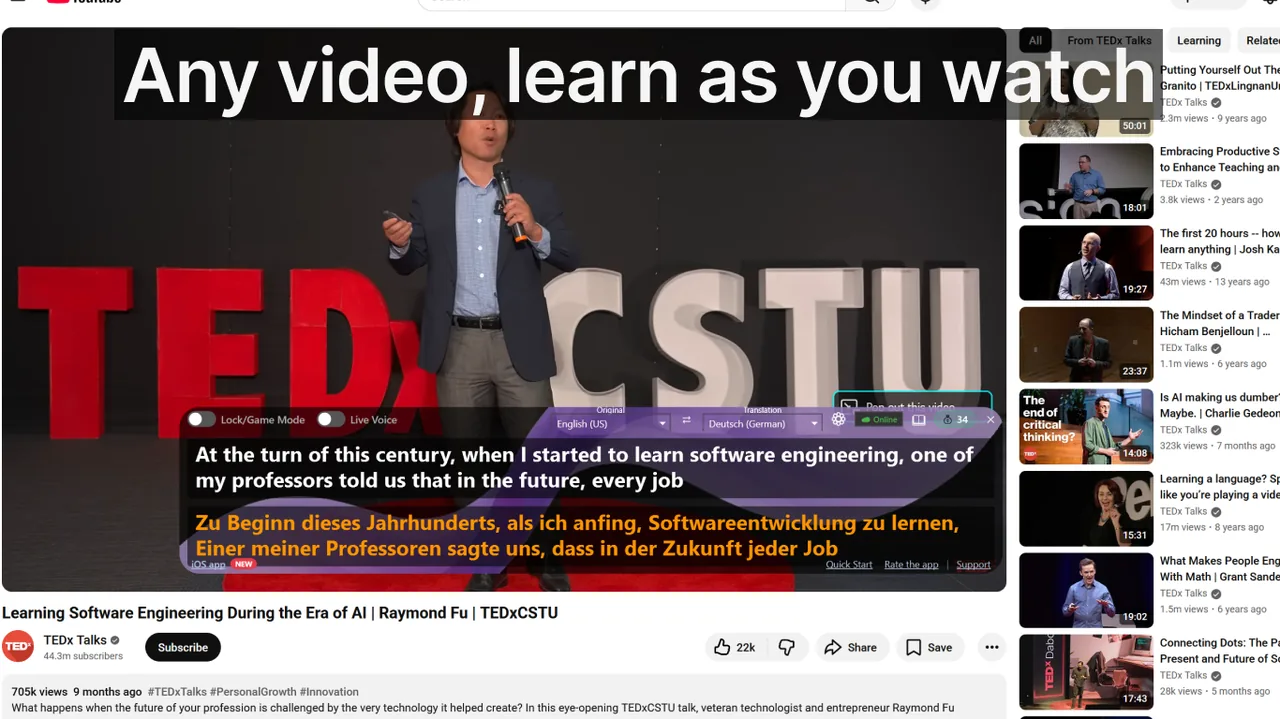
Learning a language from a textbook gives you grammar rules and vocabulary lists — but it rarely teaches you how real people actually talk. Native speakers drop entire syllables, string together idioms, use slang that never appears in coursebooks, and switch register in a single sentence. The fastest route into that living layer of the language is immersive media combined with smart subtitle use. This article gives you a concrete, step-by-step system for extracting conversational speech and slang from movies, series, and online video — and the tools that make the whole process seamless.
Contents
- Why Textbooks Cannot Teach Conversational English
- The Science Behind Subtitles and Language Acquisition
- Dual Subtitles (2-Sub): The Accelerator Mode
- Choosing the Right Content for Slang Acquisition
- A Step-by-Step Method for Extracting Slang from Video
- Using Live Subtitles for Real-Time Conversational Practice
- Specific Slang Categories Worth Targeting
- Picking Content by Accent and Dialect
- Measuring Your Progress
- Frequently Asked Questions
Why Textbooks Cannot Teach Conversational English
Formal language instruction is built around written, edited, standardised text. Even "dialogue" exercises in textbooks are scripted to exemplify grammar points, not to replicate authentic speech. The gap becomes obvious the moment you try to follow a fast-paced American sitcom or a British crime drama: characters contract words aggressively ("gonna," "wanna," "dunno"), use filler expressions ("you know," "I mean," "like"), switch between registers, and deploy slang that is sometimes regional, sometimes generational, and sometimes brand-new.
Research in second-language acquisition consistently shows that comprehensible input at or just above your current level is one of the most powerful drivers of fluency. Authentic video content is the richest source of that input — provided you can actually understand it. That is precisely where subtitles become indispensable.
The Science Behind Subtitles and Language Acquisition
Several peer-reviewed studies have examined how subtitles affect vocabulary retention and listening comprehension. A 2010 study published in Language Learning & Technology found that learners who watched videos with same-language (L2) captions outperformed those who watched without captions on both vocabulary tests and comprehension checks. A 2017 meta-analysis of 37 studies confirmed a moderate-to-large positive effect of captions on incidental vocabulary learning.
The mechanism is straightforward: when you hear an unfamiliar word and simultaneously see it in print, your brain forms two separate memory traces — auditory and visual — that reinforce each other. Slang is especially well served by this dual-encoding effect because slang terms are often phonetically irregular or heavily contracted, and seeing the spelling resolves the ambiguity that would otherwise make the word slide out of memory.
Dual Subtitles (2-Sub): The Accelerator Mode
Single subtitles in the target language are powerful, but dual subtitles — showing both the original dialogue and a translation simultaneously — compress the learning loop even further. Here is why 2-sub mode is especially effective for slang and idioms:
- Immediate meaning resolution: When a character says "That's so fetch," you do not need to pause, alt-tab to a dictionary, and lose context. The translation appears instantly beneath the line.
- Contrastive structure analysis: You see how an idiom in English maps (or fails to map) word-for-word into your native language, which deepens your understanding of why the phrase means what it does.
- Register awareness: The translation often signals whether the original is formal, neutral, or vulgar slang — metadata that a monolingual subtitle cannot provide.
- Reduced cognitive load: When you are not constantly stopping to look things up, you maintain narrative immersion, which sustains motivation and increases total watch time — the single biggest predictor of acquisition speed.
Choosing the Right Content for Slang Acquisition
Not all video content is equally useful. Documentaries tend to use formal, carefully scripted narration. News broadcasts deliver standard prestige dialect. For conversational speech and slang you want content where characters interact spontaneously and informally. Strong categories include:
Sitcoms and Workplace Comedies
Shows like The Office, Brooklyn Nine-Nine, or It's Always Sunny in Philadelphia are dense with workplace banter, sarcasm, and generational slang. Episodes are short (22 minutes), making them easy to rewatch for deep-dive sessions. The dialogue is recorded at a relatively controlled pace — faster than academic speech, but slower and clearer than action sequences.
Reality TV and Unscripted Content
Reality shows expose you to genuinely unscripted speech — false starts, overlapping talk, filler words, and colloquialisms that no scriptwriter would invent. Watch with subtitles and you will pick up authentic patterns that rarely appear in curated media.
YouTube Long-Form Podcasts and Interview Channels
Auto-generated captions on YouTube have improved dramatically and now achieve roughly 90–95% accuracy on clear studio audio. Channels like Lex Fridman Podcast, Hot Ones, or any commentary-style gaming channel give you hours of natural conversation per week at zero cost.
Youth and Teen Dramas
Shows aimed at 16–25-year-old audiences deliberately use current slang to maintain authenticity. The vocabulary here turns over fastest and is often what language learners actually want to sound like. Pair this with the top movies and series recommended for dual-subtitle learning for a curated starting list.
A Step-by-Step Method for Extracting Slang from Video
Watch the episode or video straight through with dual subtitles enabled. Do not pause. Your goal is comprehension of the narrative and emotional tone, plus passive exposure to unfamiliar expressions. Mark timestamps (mentally or with a quick note) when you encounter phrases you do not understand.
Rewatch with a notebook or a digital flashcard app open. Each time you hear an interesting phrase — an idiom, a slang term, a phrasal verb, a piece of banter — pause and write it down exactly as spoken, alongside the translated equivalent and the context sentence. Target 5–10 expressions per episode; more than that becomes overwhelming.
Choose two or three of the most interesting lines and repeat them out loud, matching the speaker's rhythm, speed, and intonation as closely as possible. This technique — called shadowing — is one of the most evidence-backed methods for improving both pronunciation and speaking fluency. Real-time subtitles let you verify that you are producing the right words even as you speak.
Add your extracted phrases to a spaced-repetition system (Anki is free and widely used). The front of the card shows the English phrase; the back shows the translation and the original context sentence. Review your deck for 10–15 minutes daily. Research on spaced repetition shows retention rates of 90%+ after 12 months compared to roughly 30% for massed study.
Within 24–48 hours of learning a new slang expression, try to use it in writing (a chat message, a forum post, a journal entry) and then in speech during a language exchange session or with a conversation partner. Production within 48 hours dramatically increases long-term retention compared to passive review alone.
Using Live Subtitles for Real-Time Conversational Practice
The approach above works well for pre-recorded content. But what about live conversations — a video call with a native speaker, a webinar, a livestream? That is where real-time speech recognition with live subtitles changes the game entirely.
The Download free
(available on the Microsoft Store, rated 4.7/5 from 351 verified reviews) captures system audio from any application and displays live captions with optional simultaneous translation. During a video call on Zoom or a live stream on Twitch, every slang expression, filler phrase, and fast-spoken idiom appears as text in real time — so you can catch it, read it, and process it at normal conversation speed without interrupting the flow to ask "sorry, what did you say?"This matters because conversational slang is highly situational. Reading "cheugy" in a glossary does not convey the ironic, slightly dismissive tone with which it is actually used. Hearing it in a live conversation while simultaneously reading the caption and translation locks in the register immediately. For a broader look at how subtitles support comprehension across different content types, see why subtitles are useful even for native speakers.
Specific Slang Categories Worth Targeting
Not all slang is equally valuable for a language learner. Prioritise these high-frequency categories:
- Phrasal verbs: "figure out," "give up," "bring up," "go off" — these appear constantly in native speech and are almost entirely absent from formal coursebooks.
- Filler and discourse markers: "like," "you know," "I mean," "basically," "right," "anyway" — mastering these makes your speech sound fluent rather than stiff.
- Intensifiers: "absolutely," "totally," "literally," "dead" (British slang for "very"), "hella" (West Coast US) — these shift dramatically by generation and region.
- Reaction words: "No way," "For real?," "Seriously?," "That's wild" — the small reactive phrases that sustain conversation feel natural only if you have heard them hundreds of times in context.
- Internet-derived spoken slang: "lowkey," "it's giving," "no cap," "slay," "vibe" — words that originated in online culture and have migrated into everyday spoken English among younger demographics.
Picking Content by Accent and Dialect
English is not a monolith. The slang of a Black British teenager in South London, a working-class New Yorker, a middle-class Californian, and an Australian surfer share a grammatical skeleton but diverge sharply in vocabulary and intonation. Before starting a systematic slang-learning project, decide which variety of English you most need to understand and find content that authentically represents it.
For General American: US network sitcoms, late-night talk shows, and mainstream YouTube.
For British English: UK panel shows (QI, 8 Out of 10 Cats), British YouTube gaming channels, and gritty urban dramas.
For Australian English: Australian reality TV, stand-up comedy specials, and ABC comedy series.
Dual subtitles in these contexts are especially valuable because slang often does not translate word-for-word — and the translation in your subtitle line shows you the functional equivalent in your native language, not a literal rendering that would make no sense.
Measuring Your Progress
Language progress is famously hard to feel in real time because the improvements accumulate gradually. Use these concrete checkpoints every four weeks:
- Rewatch the first episode of a series you watched at the start of the month without subtitles. Count how many previously opaque phrases you now understand instantly.
- Listen to a 5-minute clip of native casual speech (a podcast excerpt, a YouTube comment-reading video) and transcribe as much as you can. Compare accuracy to your baseline transcription from week one.
- Have a 10-minute conversation with a native speaker and note how many slang expressions you successfully used in context versus how many felt forced or were avoided.
A realistic timeline: with 30–45 minutes of active subtitle-assisted watching per day plus daily flashcard review, most B1-level learners report a noticeable improvement in slang recognition within 6–8 weeks and comfortable active use within 4–6 months. For more on content selection that maximises these gains, check out our guide on how movies help you understand culture and mentality.
Frequently Asked Questions
Should I use subtitles in my native language or in English?
At beginner to low-intermediate level, native-language subtitles (or dual subtitles) are strongly preferable — the cognitive overload of unfamiliar audio without any anchor causes learners to tune out and learn nothing. From upper-intermediate level, switching to target-language-only subtitles forces deeper lexical processing. For slang specifically, dual subtitles remain useful at any level because the register information they provide is hard to infer from context alone.
How many new expressions should I target per session?
Research on vocabulary acquisition suggests that 5–10 new items per session is the sweet spot for most learners. More than that and consolidation suffers; fewer and you are under-utilising your study time. For a 22-minute sitcom episode, that typically means pausing for active extraction on roughly 5–8 occasions — sustainable without breaking immersion too aggressively.
Does shadowing really help with slang specifically?
Yes — slang often involves non-standard stress patterns, elision (dropping sounds), and unusual intonation contours. You cannot learn these features by reading alone. Shadowing, especially with a real-time subtitle display as a safety net, trains your articulatory muscles to produce the exact phonetic pattern that marks the expression as natural rather than stilted.
Can I use this method for languages other than English?
Absolutely. The same principles apply to any language with a rich media ecosystem. The Live Subtitles app supports over 50 languages, so dual-subtitle learning is accessible for learners of French, Spanish, German, Japanese, Korean, and many others.
Related Articles
Try Live Subtitles for Free
Get dual subtitles, real-time speech recognition and translation in any application. Works with YouTube, Netflix, Zoom, and 50+ other apps.
Download free